

State governments are increasingly stepping in to ensure local governments allow more housing construction, according to new findings released by the NYU Furman Center.
Drawing from the Land Use Reform Tracker, a resource designed to provide a deeper understanding of how the land use policy landscape is changing nationally, the NYU Furman Center published three research and policy briefs that compare state approaches across different categories of land use reform: planning requirements, the builder’s remedy, and procedural reforms.
“While state planning mandates have existed for decades, states are becoming far more prescriptive about pairing local planning requirements with zoning reforms to accommodate more housing,” said Helen Ketema, Research Associate for State Housing and Land Use Policy, during opening remarks before a panel discussion moderated by NYU Furman Center Faculty Director Vicki Been.
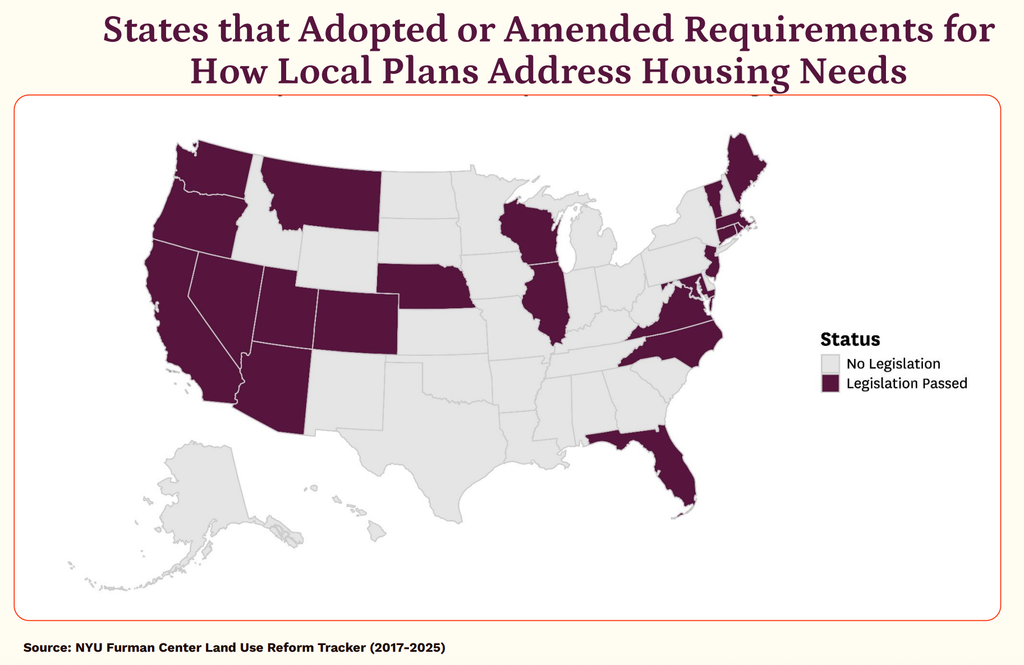
State interventions on local land use planning
States around the country have been examining how to use various levers at their disposal to design frameworks to calculate regional housing demand and assign enforceable targets for how much local jurisdictions must permit.
In New Jersey, the state’s regional allocation model stems from the landmark Mount Laurel Doctrine. The law was updated in 2024 to codify the fair share housing calculation methodology to bring greater predictability into the process.
Katherine Payne, Managing Director of Operations and Senior Planner at the Fair Share Housing Center, said the state has been consistent that fair share numbers be allocated locally based on regional needs, saying it allows for a “more context-sensitive approach.”
“[It] allocates housing in places where it’s needed most–places that are closer to infrastructure, closer to job centers, in less environmentally-sensitive areas, and places that really have lower comparative levels of affordability compared to the broader three or four county region,” Payne said, during the panel discussion.
Towns, she said, end up having more agency around where housing is placed within its borders under this approach.
Washington State has followed a similar path, according to Anne Aurelia Fritzel, Housing Section Manager at the Washington State Department of Commerce.
In 2025, the state transitioned from solely encouraging affordability toward a stricter requirement for local jurisdictions in adopting housing plans that accommodate countywide housing targets allocated by the state. However, it has been met with real challenges for municipalities.
“Once you’ve figured out what your needs are–those conversations at the local level to allocate housing needs, especially lower ones, have been really hard,” said Fritzel. “And so we’ve seen several counties just really struggling to adopt those targets.”
Navigating litigation and enforcement mechanisms
States have also adopted a variety of tools to secure compliance, including the builder’s remedy, which provides individual development projects the ability to bypass restrictive local land use regulations. It also serves as both a compliance incentive and an enforcement tool against non-compliant localities.
Currently, eight states have active builder’s remedy laws: California, Connecticut, Illinois, Massachusetts, New Hampshire, New Jersey, Rhode Island, and Washington. Panelists highlighted how different state statutory frameworks handle the legal friction that often accompanies these mandates.
For example, Massachusetts, which has one of the oldest builder’s remedy statutes in the nation commonly referred to as 40B, allows zoning to bypass in municipalities where less than 10% of housing stock is affordable.
Amy Dain, Senior Fellow at Boston Indicators, said the mechanism has proven far more effective at delivering actual zoning changes and housing units than voluntary incentives or planning persuasion.
On the West Coast, California is tackling enforcement compliance differently, by pursuing state litigation and financial penalties alongside its builder’s remedy. There, state law empowers the attorney general to request court fines of $10,000 upfront, and $50,000 per month against any non-compliant cities.
When Huntington Beach refused to adopt a compliant housing plan, it accumulated $160,000 in fines before ultimately folding and adopting its housing element, said Bill Fulton, Co-Director of the Center for Housing Policy and Design at UC San Diego and Fellow for the Terner Center for Housing Innovation at the University of California, Berkeley. He also noted that the builder’s remedy litigation is heavily concentrated in high-income areas, where market-rate rents can subsidize affordable units.
California also has shifted the legal burden of proof onto local governments in land-use litigation. Rather than requiring developers to prove a town acted improperly, local governments must now legally justify housing denials or restrictions in court.
“It doesn’t only affect the actual litigation cases,” said Fulton. “It also affects the psychology of both the developers and the cities. The developers are very aggressive now, the cities are very much on the defensive.”
Other states, like New Jersey, are also reforming the legal process surrounding enforcement. The state recently adopted a bill (NJ A4/S50) establishing the Affordable Housing Dispute Resolution program, which appoints judges to resolve compliance disputes outside of lengthy court battles.
“It was designed to be less expensive and much faster than a protracted legal process,” Payne said. “That really benefits towns, particularly towns that want to cooperate, because the law established really clear deadlines and milestones that towns have to hit in the affordable housing planning process, or they will lose immunity from builder’s remedy lawsuits.”
Speeding up local approvals with procedural reforms and burden-shifting
States have also sought legal interventions aimed at reducing the delays, costs, and uncertainty imposed by local discretionary review processes when it comes to expanding the housing supply.
Massachusetts learned first hand the political and administrative effort required when directing 177 local communities to establish multi-family zoning districts as-of-right under the state’s MBTA Communities Act of 2021. While each eventually complied, it cost millions of dollars to implement and state leadership.
“There were planners in tears over this,” said Dain. “[It] took so much political capital to get this passed in town, city after city.”
Instead, she pointed to Massachusetts’ statewide legalization of accessory dwelling units (ADUs), which did not require local governments to rewrite municipal zoning codes as a better approach. “That happened very quickly, without all of these court cases, the pushback, the opposition, the exhaustion, and the tears of planners.”
California, too, has shifted away from local discretionary reviews toward mandatory ministerial approvals. The state now pairs 100% density bonuses with ministerial processing, preventing local officials from arbitrarily blocking projects that request waivers or concessions on height, setbacks, or parking.
“Just this year, the legislature passed a bill saying that the waivers and concessions are not a discretionary decision on the part of the local governments,” Fulton said.. “So, the developer that walks in the door, says, ‘I want to blow out the height and the setback,’ and there’s nothing the city can do about it.”
Similarly, Washington State has also enacted preemptive legislation legalizing ADUs, middle housing, transit-oriented development, and single-room occupancy units while streamlining local permitting procedures.
Addressing implementation realities, capacity limits, and future state leadership
The reality of implementing state land use reforms, addressing severe resource constraints in smaller municipalities, and identifying the necessary components for long-term success has proven to be an ongoing challenge, panelists agreed.
From smaller towns that lack the planning capacity and financial resources needed to fulfill complex housing targets to the sheer volume of new mandates have placed an immense strain on local officials, they noted. Adding that, rigorous state requirements have put a lot of undue stress on small planners as they struggled to meet tight statutory deadlines.
Still, while legislative reforms are complex, strong statewide mandates backed by clear enforcement remain essential to tackling the housing shortage.
“There is no one silver bullet to fixing the housing affordability crisis,” said Payne. “Statewide housing requirements have been incredibly helpful, because left to local politics entirely, a lot of communities would continue to underproduce housing, especially multifamily and affordable homes.”